
FreshCheck
The Smart Label that Tracks Food Freshness in Real-Time
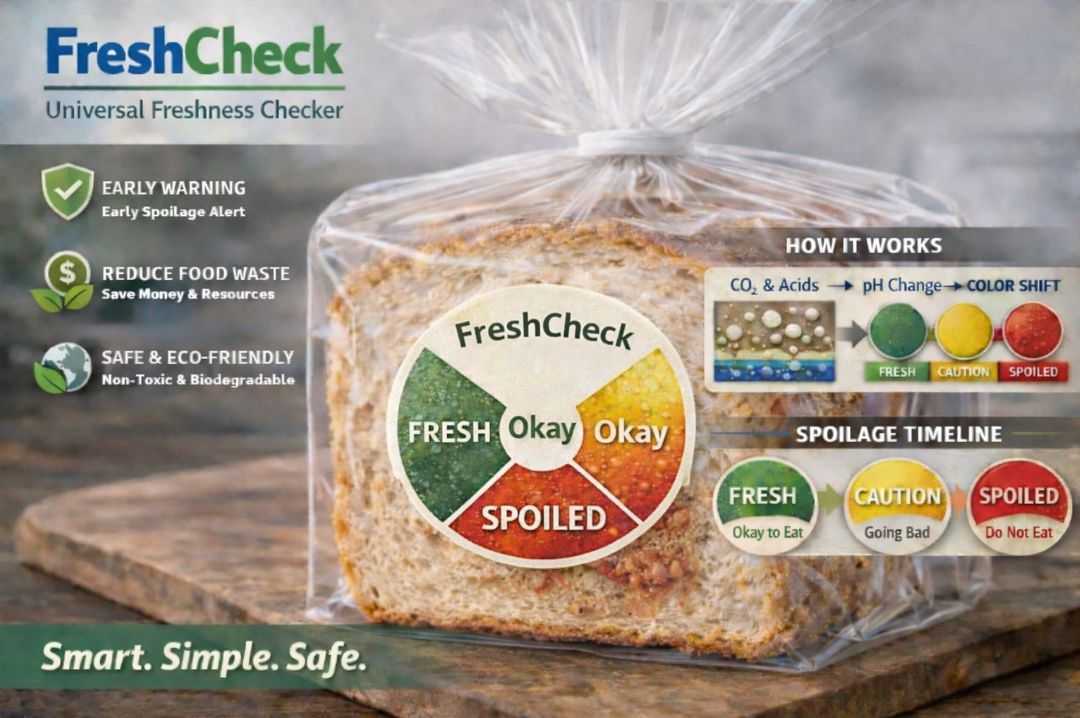
Our team has developed FreshCheck initially for bread because it is one of the most widely consumed and frequently wasted foods. The FreshCheck sensor can also be adapted for other food items with minimal adjustments to the sensing chemicals, tailored to the specific spoilage gases each food releases. We plan to develop additional sensors for a wider range of food products in the near future.
How Bread Spoils
Bread spoils primarily due to the growth of mold. As mold develops, it carries out metabolic respiration and continuously releases biologically generated carbon dioxide (CO₂) along with small amounts of organic acids. These chemical byproducts are produced well before visible mold growth or unpleasant odors appear, making them reliable early indicators of spoilage. Unlike normal atmospheric carbon dioxide, which exists at low and stable concentrations, mold-produced carbon dioxide accumulates continuously inside sealed bread packaging. FreshCheck is specifically designed to detect this sustained biological activity, ensuring that normal background carbon dioxide does not trigger a false response.
Gas-Permeable Barrier & Selective Gas Detection
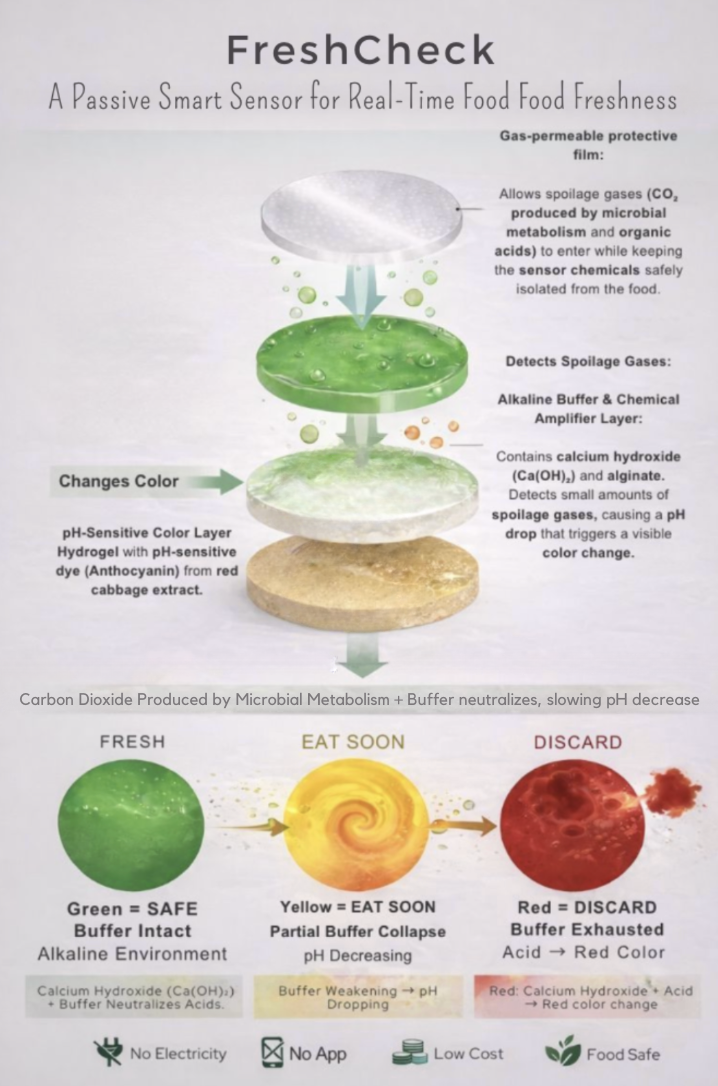
FreshCheck includes a gas-permeable but food-isolating protective layer positioned between the bread and the sensing chemistry. This layer allows spoilage gases such as carbon dioxide (CO₂) to diffuse into the
sensor while preventing direct contact between the sensor and the bread. This ensures food safety, prevents contamination, and maintains sensor stability. Because only gases generated inside the package can pass through this layer and accumulate, external atmospheric air does not interfere with the sensor’s function.
Carbon Dioxide (CO₂) Detection & pH Change
When carbon dioxide (CO₂) from mold passes through the gas-permeable layer, it enters the water-containing part of the sensor and reacts with water to form carbonic acid. The sensor contains calcium hydroxide (Ca(OH)₂), which acts as an alkaline buffer. Carbonic acid reacts with this buffer to form calcium carbonate and water. This reaction gradually consumes the buffer, causing a controlled decrease in pH that directly reflects ongoing mold activity. Because the buffer must be continuously depleted, the sensor responds only to sustained biological spoilage rather than short-term exposure to air.
pH Thresholds & Spoilage Stages
FreshCheck converts the gradual pH change into clear freshness information. Fresh bread typically has a pH between 5.6 and 6.0, and the sensor starts green at packaging, signaling that the bread is safe to consume. As mold begins to grow and respire, the release of carbon dioxide (CO₂) and organic acids lowers the pH to approximately 5.2-5.5, causing the sensor to turn yellow, indicating early spoilage. When mold activity becomes advanced and the pH falls below 4.8, the environment becomes strongly acidic, and the sensor changes to red, clearly signaling unsafe, fully spoiled bread. Because the alkaline buffer must be gradually consumed by sustained, biologically generated carbon dioxide, short-term exposure to normal atmospheric air does not produce a color change, preventing false positives.
Color Change Mechanism
The visible color change in FreshCheck is produced by anthocyanins extracted from red cabbage, which are natural pH-sensitive pigments. The sticker is green from manufacturing, reflecting the anthocyanins’ appearance at the initial higher pH. As the pH decreases during food spoilage, the anthocyanins’ molecular structure changes, causing the color to shift from green to yellow and finally to red. At low pH, anthocyanins convert into their flavylium cation form, a positively charged structure that absorbs light differently and produces a red color. This molecular transformation provides a clear and irreversible visual indication of spoilage.
Manufacturing & Scalability
FreshCheck is designed for low-cost, industrial-scale production. Anthocyanin extracts are mixed with sodium alginate to form a hydrogel, while calcium hydroxide is prepared as a controlled buffering component. These materials are deposited onto biodegradable cellulose or PLA substrates using simple pipetting or printing techniques. The layers are then crosslinked using a mild calcium chloride (CaCl₂) spray and air-dried to create a stable and durable sensor. This process is compatible with existing label-printing infrastructure, requires minimal energy, and avoids complex electronics.
Why FreshCheck is Reliable
FreshCheck responds only to continuous, biologically generated carbon dioxide (CO₂) produced by mold respiration. Because mold must actively grow and metabolize to trigger the chemical reactions inside the sensor, FreshCheck avoids false positives from normal air exposure. This makes it an accurate, electricity-free, food-safe, and sustainable solution for early bread spoilage detection and food waste reduction.